
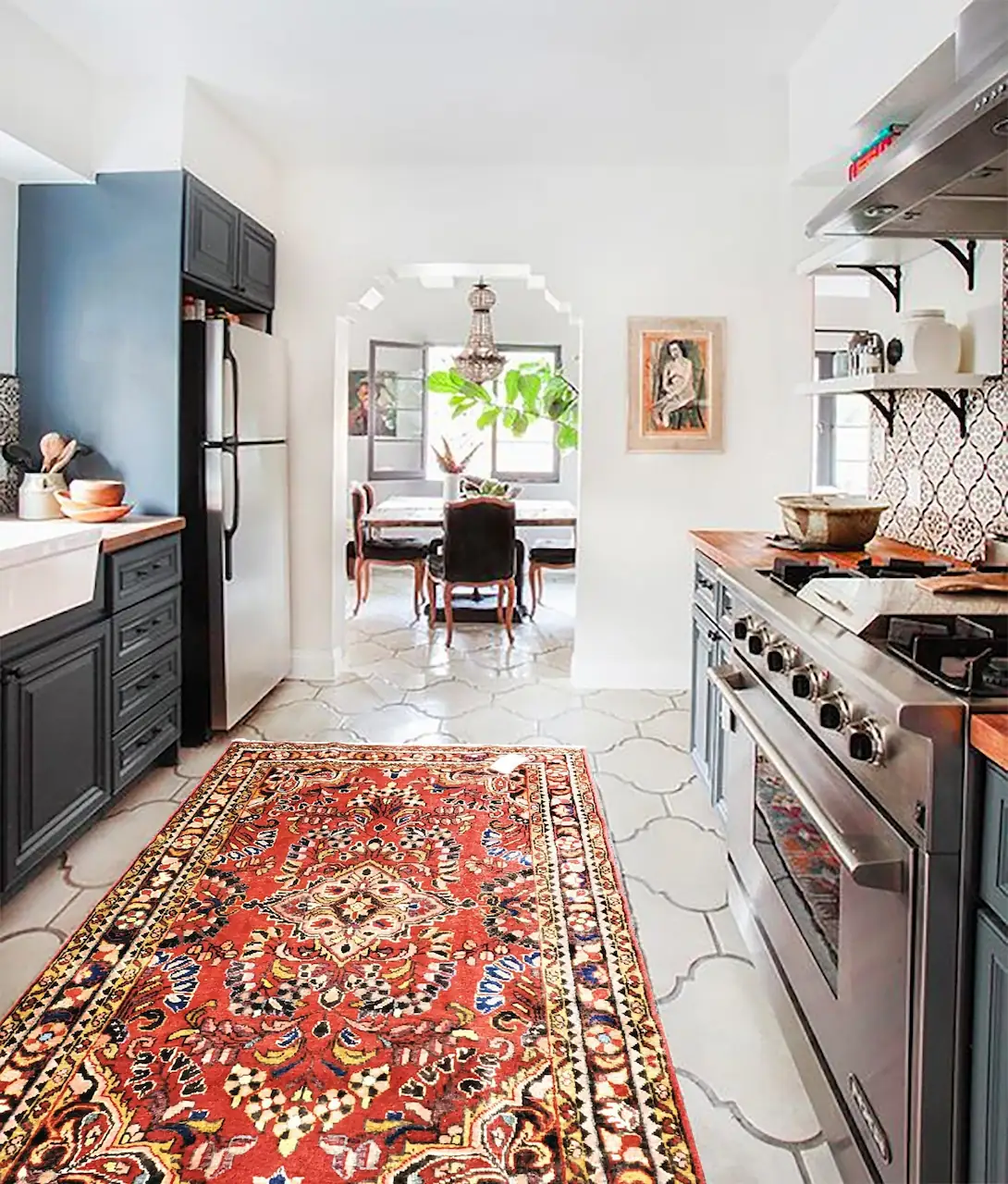
Two rugs can look totally different—one crisp and “perfect,” one worn and mellow—yet the worn one can be far superior in quality. The key is learning to separate cosmetic condition from true merit: pattern, colour, materials, and workmanship.[1]
Here’s how to see quality the way a collector does.
1. Pattern: complexity vs shortcuts
Older high‑quality rugs show elaboration, not shortcuts.[1]
Strong quality signals:
- Fields packed with detailed motifs: flowers, vines, trellis work, repeating classics like Herati or pear patterns drawn with finesse.[1]
- Borders that do real work: multiple stripes, each with its own small-scale pattern, not just a single big band of colour.
- Almost no “dead” spaces—small motifs fill gaps instead of leaving empty ground.[1]
Warning signs:
- Oversized, simplified motifs with very little interior detail.
- Large unpatterned zones of solid colour—classic “labour‑savers” from modern commercial weaving.[1]
- Borders that feel like afterthoughts: one wide stripe with a simple repeating motif.
A rug can be faded or worn in places and still reveal the original ambition of its patterning. That ambition is part of its quality.
Colour is one of the quickest tells of both age and merit.[1]
Quality traits:
- Vegetable‑dyed colours that have mellowed over time into complex, rich tones rather than shouting brights.[1]
- Classic “old” shades that modern synthetics struggle to mimic:
- Deep but soft blues,
- Rose‑pinks and wine‑reds,
- Warm “old ivory.”[1]
- Smooth, graceful meeting points between colours—no bleeding or feathering.
Lower merit traits:
- Flat, harsh versions of red, purple, and blue that read obviously synthetic.
- Heavy use of chemical‑looking magenta; these shades are specifically flagged as signs of modern dyeing in some regions.[1]
- Colour edges that look blurred, suggesting the dyes have “run.”[1]
A rug can be sun‑softened or slightly uneven in colour and still be excellent. What matters is the underlying quality of the dyes and harmony of the palette, not whether every patch is uniform.
3. Materials: what’s under the pretty surface
Under the pattern, older fine rugs often used better raw materials: high‑quality wool and, in many town pieces, cotton warps for strength.[1]
What to value:
- Supple wool pile that still has some sheen even when worn—this reflects better wool and careful shearing.
- Foundations (warps/wefts) that are intact and strong; in good old rugs the structure often survives even when pile is gone in spots.[1]
- For many Persian town rugs, cotton warps are a positive clue—it’s what local weavers had ready access to.[1]
What to be cautious of:
- Very dull, lifeless wool combined with heavy, coarse pile—typical of many modern Indian production rugs aimed at the mass market.[1]
- Foundation threads that break when lightly bent or examined, suggesting rot or very poor fibre.
Good bones matter more than perfect skin: a strong foundation is what determines whether a rug can go on living on your floor.
4. Workmanship: weave and “feel”
Workmanship is where you stop thinking like a stylist and start thinking like a maker.[1]
Indicators of strong workmanship:
- Even, consistent rows of knots across the back, with no sloppy spacing or big irregular gaps.[1]
- A handle that’s limp and flexible, especially in older pieces; they should not feel stiff or board‑like.[1]
- Backs that are hard‑woven and level—older rugs often feel almost like a firm textile rather than a loose mat.[1]
Contrary to dealer clichés, the number of knots per inch is not a universal quality metric. It’s useful when comparing two rugs of the same type, but across regions and traditions the knot count is part of the style, not a ranking system.[1]
5. Condition: damage vs honest wear
Delabère May points out that a rug’s “condition” is a slippery measure of age—one year of hard use can equal 50 years of gentle use.[1]
Good, honest wear:
- Overall thinning of pile in traffic paths, but design still legible.
- Slight fraying at ends/edges that has been properly stabilized.
- A face that looks lived‑in, but a back/foundation that is sound.
Problematic condition:
- Large areas where the foundation is bare and broken.
- Amateur repairs that ignore the original pattern (e.g., random yarns stuffed into holes).
- Chemical “washing” to fake age—this can strip wool, leaving it harsh and lifeless.[1]
A slightly worn, beautifully drawn rug with good colour and strong structure is often a better buy—and a better story—than a “perfect” rug woven cheaply last decade.
6. Market value: what your eye + the market say
Once you’ve judged type, age, and merit, value is ultimately what informed buyers are paying in the market.[1]
- Old, well‑made rugs are finite; the book already noted prices rising sharply as supply dwindles and collectors finally recognize their worth.[1]
- This is why some lightly worn, 60‑year‑old village pieces cost more than brand‑new “designer” rugs: you’re buying scarce, high‑merit work, not just floor coverage.
When you’re browsing SaraMoon, this is what we’re doing behind the scenes: grading pattern ambition, dye quality, materials, structure, and repairs—so that when you choose between “excellent vintage” and “good, gently worn,” you’re weighing true quality, not just cosmetics.[1]